Innocence and History in Forrest Gump
The 60s have held a fascination in the minds of millions across the world— the Beat Generation, the hippie culture, Joan Baez, Holden Caulfield, the Beatles, lifting the ban off Lady Chatterley’s Lover, Catch 22 etc have appealed to the rebellious desires of artists, writers and filmmakers for years. In the romance of the rebellion, it is easy to forget what it was that gave strength to this counterculture—the Vietnam War. American cinema is flooded with films about the Vietnam War and it is interesting to note that an entire chunk of these films were made in the 90s. Most of these films are centered around a sense of loss and hopelessness as they base themselves on (and at the same time also create) the veteran discourse.
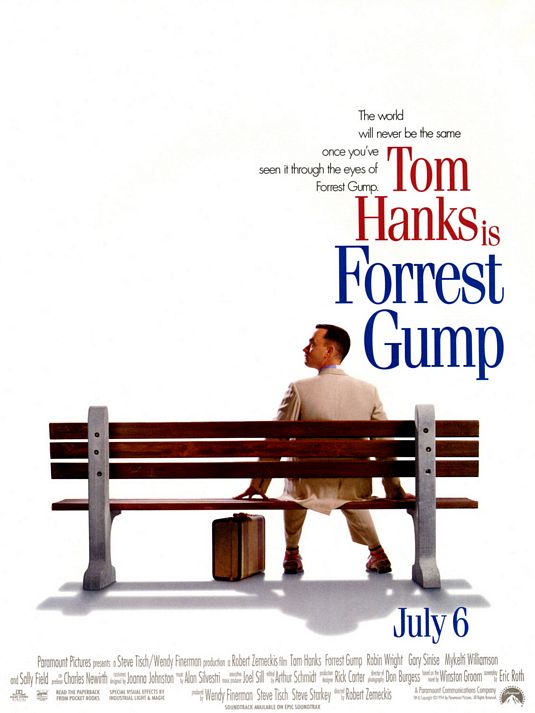
Robert Zemeckis’s multiple Oscar-winning film, Forrest Gump (1994) isn’t just about the Vietnam War though it tells the story of a war veteran. It records the history of America in and around the 1960s through the figure of a slow-witted man, Forrest Gump (Tom Hanks). In this paper, I would like to discuss how Zemeckis’ representation of the Vietnam War is significantly different from most accounts of the War, especially a film like Oliver Stone’s Platoon, and why Zemeckis feels the need to take a somewhat simplistic view of history. Is it that by the 90s America had finally reached a place where the trauma had been dealt with and there was space for alternative views on the War in popular culture? Or is it embedded in a more political reason, whereby a conservative worldview had to be justified and encouraged?
The 60s have held a fascination in the minds of millions across the world— the Beat Generation, the hippie culture, Joan Baez, Holden Caulfield, the Beatles, lifting the ban off Lady Chatterley’s Lover, Catch 22 etc have appealed to the rebellious desires of artists, writers and filmmakers for years. In the romance of the rebellion, it is easy to forget what it was that gave strength to this counterculture—the Vietnam War. American cinema is flooded with films about the Vietnam War and it is interesting to note that an entire chunk of these films were made in the 90s. Most of these films are centered around a sense of loss and hopelessness as they base themselves on (and at the same time also create) the veteran discourse.
Robert Zemeckis’s multiple Oscar-winning film, Forrest Gump (1994) isn’t just about the Vietnam War though it tells the story of a war veteran. It records the history of America in and around the 1960s through the figure of a slow-witted man, Forrest Gump (Tom Hanks). In this paper, I would like to discuss how Zemeckis’ representation of the Vietnam War is significantly different from most accounts of the War, especially a film like Oliver Stone’s Platoon, and why Zemeckis feels the need to take a somewhat simplistic view of history. Is it that by the 90s America had finally reached a place where the trauma had been dealt with and there was space for alternative views on the War in popular culture? Or is it embedded in a more political reason, whereby a conservative worldview had to be justified and encouraged?
I
The problem with Forrest Gump begins with the beginning, “Life is like a box of chocolates, you never know what you’re going to get.” True to this opening line, the film treats American history of the decades between the 1950s and the 1970s as a box of chocolates; you might not know what flavour you are going to get, but whatever it is, it will still be chocolate. The view of history the film will adopt can be ascertained by the fact that the original quote in Winston Groom’s book on which the film is based, was, “…bein’ an idiot is no box of chocolates.” In the film, Forrest flows in and out of events that shaped American history, particularly in the 1960s, like George Wallace and the desegregation of Alabama University, the Watergate Scandal and the Vietnam War etc. Through Forrest, we see a linear American history¾no mistakes, no looking back, just success. Simple. Encapsulated. In this triumphant march of history, or rather of America, the representation of the Vietnam War is what suffers the most. Numerous critics have debated the conservative or radical impulse of this film, but it is in the representation of the War and the counterculture that the film becomes conservative.
In the latter half of the 80s and through the 90s, America saw an intellectual and artistic revival of the experience of the war in Vietnam where the United States sided with South Vietnam against the Communist regime of North Vietnam. The Vietnam War was the subject of more than thirty films that appeared in this period, the most widely acclaimed of which is Oliver Stone’s Platoon. As Marita Sturken says, Platoon was marketed as ‘the first real Vietnam film’ because of its autobiographical content.[1] Through the film, we are rooted in the landscape of Vietnam and the feeling of no escape is transferred from the soldier to the spectator for whom that landscape is as alien. The film begins with the ominous image of dead bodies wrapped up, ready to be sent back; this is the first view of Vietnam for the protagonist Chris Taylor (Charlie Sheen) as well as the spectator. The film doesn’t spare us the brutality that ruled that space and time, and this is most evident when Taylor fires at a Vietnamese boy who is expected to keep jumping from one side to the other to protect himself from the shots. Taylor can’t seem to understand why he is doing what he is, he doesn’t understand the anger that is growing inside him, which he decodes only when the film closes, he says, “we weren’t fighting the enemy, we were fighting ourselves…the enemy was within us.” There is death everywhere, not just of American soldiers, but also of the Vietnamese, American GIs burn down entire villages, kill innocent civilians and even attempt a gang rape. There is a critique of the self (read the American), its brutal abilities and the role it plays in the carnage that is made most visible through the film.
Forrest Gump too looks at the Vietnam War, it uses the traditional vocabulary and references¾ the use of the word ‘Charlie’, the reference to the incessant rain, the weapons used, the phones connecting the lieutenant of a platoon to the base camp etc— yet it depicts a different, a softer history. Unlike the opening shot of Platoon, when Forrest appears in Vietnam, the mise en scene is that of a beach party, there are barbeques and stacks of beer cans everywhere, there are GIs playing cards, and there is music in the background. In fact, the comic is introduced in the next scene in an overlap between Forrest’s omniscient narrative and mise en scene. When the GIs are patrolling, Forrest’s omniscient narrative voice says, “Lieutenant Dan was always getting these funny feelings so he’d tell us to get down, shut up.” And then Lieutenant Dan (Gary Sinise) repeats, “get down, shut up.”
Most importantly, we don’t see any Vietnamese people in Vietnam. We don’t see the Americans as aggressors in any way, only as helpless GIs—all of whose names and hometowns have been discussed by Forrest—who merely defend themselves, against the faceless oppressors. Quite naturally, the spectator’s sympathy is directed towards the young, innocent, injured familiar figure of the American GI, not with the faceless Vietnamese attacker. In the way the War appears in this film, even in their defense, the Americans didn’t kill or injure a single Vietnamese, because the only dead and injured that we see are the Americans.
It is interesting how Zemeckis tries to deal with the political situation of very real events and at the same time tries to distance himself and his film from any direct political comment. He shirks the responsibility of the statements made through the film by focusing on the innocence that Forrest embodies. The pretence is that of an ‘objective’ history; for instance, he places the blame of the injuries and death in the war on a loosely defined entity, that is never shown and hardly ever referred to directly. Whatever else this entity may be, it is not American, so there is no space for self-reflexivity. In Platoon, there is a sense of guilt that comes across in Sergeant Elias’s (Willem Dafoe) statement, “…what happened today is just the beginning, we are going to lose this war…we’ve been kicking other people’s asses for so long, I figure it’s time we got ours kicked.”
The impact and suggestions of Forrest Gump regarding Vietnam are very different from other such films where the spectator and the filmmaker have to come to terms with the destruction and the unending sense of doom that stems from the fact that USA lost the War, something that Zemeckis chooses not to mention. The real difference therefore lies in the struggle with the self and its sense of morality and also with one’s country that continues to be hailed as the moral saviour of the world in the moment when films like Platoon were made. It is the lack of this struggle that marks Zemeckis’ film, where events flow with so much ease that the War, the loss and the entire age seem mocked at.
II
The question that needs to be answered, however, is why the last fifteen years of the 20th century keep coming back to the 60s moment. There are two broad possibilities:
First; as Marita Sturken says, “American society slouches toward the 21st century as a culture deeply suspicious of its history. We have moved from various phases of late modern optimism into cold-war fears, from 1960s disillusion to a late 20th century culture in which conspiracy theory forms a primary narrative…the contemporary paranoia of American culture and about American history can be seen as a direct outcome of the political and social upheaval of the 1960s.”[2]
So while Platoon occupies one end of the spectrum with Stone’s deeply critical view of the Vietnam War, Forrest Gump occupies the other where not only is the significance and impact of the War underplayed and shielded from the viewer, but the American GI is looked at most uncritically. Look at the figure of Forrest. He is the physical embodiment of all boy-scout qualities—he is honest, courageous, loyal and masculine (in his chivalry, also physically, he is a star football player, and during the War, he has the physical strength to carry his injured friends to safety). Very early in the film, we are told that he has an IQ of 75, a mere five points lower than the level required for public schools. In every other way he surpasses ‘normal’ – he is emotionally intact and knows how to respond to love, jealousy, disappointment etc, he is successful, humble, and an eager parent. In other words, he is good at everything he does. The lack of cynicism that functions as the catchphrase of the film is a result of a careful process of selection done by Zemeckis from the original novel. Zemeckis decides to leave out almost all of Forrest’s failures as they appear in Groom’s text—that he went to a special school, failed in college, could not marry his friend Jenny, smoked pot and had an incredibly troubled relationship with his son.[3]
The publicity material for this film stated, “Forrest is the embodiment of an era, an innocent at large in an America that is losing its innocence.” Losing its innocence perhaps because of the darker side of benevolent America with its sensitive, heroic, self-sacrificing soldiers is explored and thus made available for the world to see by films like Platoon and earlier by a film like Soldier Blue.
Second: till the collapse of the Soviet Union, the United States of America focused in everyway at containing Communist forces across the world. The Cold War was depicted as the war over evil and liberty. With the end of the Cold War there was a disintegration of this focus and a sense of direction. American authorities could not afford to let go of the status of the saviours of democracy and freedom. Secretary of State James Baker addressed the World Affairs Council in March 1990. He said, “Already a great, new debate —actually a great, old debate —has broken out, an argument as old as our republic. Now that the adversaries of democracy are weaker, some say we should retire, mission accomplished, to tend our problems at home. I am not among them. In the new world struggling to be born, like the old world now rapidly passing away, there is no substitute for American leadership.”[4]
At this point the United States was also looking at interference in a number of other countries, the Gulf and Central America for instance. The public had to be convinced of this foreign policy, they had to be convinced of the reasons for fighting this war that had no direct consequences for the American people. The larger-good-of-mankind argument had to be made in the context of the Gulf War. And since a similar argument was used for Vietnam, the ghosts of that war had to be touched up and re-presented. In Forrest Gump’s version of the Vietnam War, there is less violence, one death (of Forrest’s friend Bubba) and the possibility of looking forward—the Vietnam War introduces Forrest to ping-pong, bringing him fame (he meets the President again and appears alongside John Lennon on The Dick Cavett Show) and money to start the shrimping business which in turn brings him more success and financial security. Ironically, it seems as if Forrest Gump begins where Platoon leaves off, where Taylor says, “Those of us who did make it, have an obligation to build again, to teach to others what we know and to try with what’s left of our lives to find a goodness and meaning to life.”
There was a need in the 90s therefore to bend popular opinion towards ideas of a free world that America had an obligation to build, and it was necessary to convince the public to ensure that a counterculture like the one that appeared in the 60s didn’t raise its head again.
Thus the other indicator of Forrest Gump’s conservative nature is the representation of the counterculture of the 60s. In the film, the counterculture is signified through the figure of Jenny (Robin Wright), Forrest’s friend, object of desire and ultimately his wife. Through Jenny, the counterculture is represented as the darker side of American history, that which was unsuccessful and destructive.
Despite their friendship, Jenny is always the anti-thesis of Forrest. She is engendered in an atmosphere of abuse and has no stable home at any point during the film. She avoids her father’s house, and then moves in with her grandmother who lives in a trailer; Jenny is seen at every point in the film near cars and buses—means of escape, leaving for someplace where she’ll look for meaning. This is reflective of the very mobile hippie culture that she invariably becomes a part of. Not daring to think out of the box, Zemeckis places her in very traditional images of drugs, prostitution, suicide attempts, abusive relationships, and misguided youth—represented through the leader of the Black Panthers Party whose personality comes across as confused, aggressive and astray—and not surprisingly, all of these become characteristics of the counterculture. At various junctures of the film, Forrest comes to her rescue, the most interesting of which is the episode at the headquarters of the Black Panthers Party where in spite of his agitated speech about women being mistreated as a result of the War, the leader and his entire group stand and watch as Jenny’s boyfriend beats her, it is only Forrest who intervenes. Until she decides to unite with Forrest, Jenny, and hence the counterculture is a failure. Constructive aspects of the counterculture like its art, literature and music are conspicuously ignored or ridiculed—for instance, Jenny aspires to be like Joan Baez, and while we do see her singing ‘Blowing in the Wind’, she is doing it in a strip club where no one is paying attention to her song. Through the protesters who force unknowing people (like Forrest) into the peace congregation, the ‘host’ at this congregation who wears the American flag and repeatedly uses obscenities encouraging the mob to cheer, and through the leader of the Black Panthers, the counterculture is not only severely criticised but also caricatured.
We see both Forrest and Jenny growing up together, but since the film is his (fictional) biopic, we see the process of his growth, while she is seen in relation to him. We see him as a witness or a participant in the events that shaped 20th century American history, and this is achieved most convincingly through the interpolations in documentary images that are used throughout the film—he meets almost every president of the United States, he is present at the desegregation of Alabama University, he cracks the Watergate Scandal leading to Nixon’s resignation, and he is a soldier fighting in Vietnam. Jenny’s life however is not seen as a selection of events, but as moments. They are more like snapshots that have no explanation, they are just images. The corroboration of his history with actual events are in contrast to her history, which is caricatured, and also, in comparison, open to debates about authenticity. This establishes Forrest’s as the master narrative, the mainstream, and hers as the disturbed fringe that is tolerated as an unfortunate detail.
The closing decade of the 20th century saw a culture of affluence in the United States; in the Introduction to a New Yorker anthology, David Remnick says, “The American record of economic growth (was) unprecedented and, since March 1991, uninterrupted, and (had) inscribed itself on the landscape¾the McMansions of suburbia, the princely constructions along the oceans, the real-estate manias from Manhattan to Palo Alto…” Remnick recalls a sentence from The Great Gatsby, “He had come a long way to this blue lawn and his dream must have seemed so close that he could hardly fail to grasp it.” he places this sentence at the heart of the contradiction that defined America in its ‘moment of prosperity, satisfaction and self-satisfaction’.[5] It was perhaps this contradiction of the ‘New Gilded Age’ that lead to the oppositional instincts of self-satisfaction and self-exploration.
Despite its simplified representation of the Vietnam War and the counterculture, some of these contradictions occupy Forrest Gump as well, because the Vietnam War is just one aspect of this film, and therefore all questions are not yet answered.
The problem with Forrest Gump begins with the beginning, “Life is like a box of chocolates, you never know what you’re going to get.” True to this opening line, the film treats American history of the decades between the 1950s and the 1970s as a box of chocolates; you might not know what flavour you are going to get, but whatever it is, it will still be chocolate. The view of history the film will adopt can be ascertained by the fact that the original quote in Winston Groom’s book on which the film is based, was, “…bein’ an idiot is no box of chocolates.” In the film, Forrest flows in and out of events that shaped American history, particularly in the 1960s, like George Wallace and the desegregation of Alabama University, the Watergate Scandal and the Vietnam War etc. Through Forrest, we see a linear American history¾no mistakes, no looking back, just success. Simple. Encapsulated. In this triumphant march of history, or rather of America, the representation of the Vietnam War is what suffers the most. Numerous critics have debated the conservative or radical impulse of this film, but it is in the representation of the War and the counterculture that the film becomes conservative.
In the latter half of the 80s and through the 90s, America saw an intellectual and artistic revival of the experience of the war in Vietnam where the United States sided with South Vietnam against the Communist regime of North Vietnam. The Vietnam War was the subject of more than thirty films that appeared in this period, the most widely acclaimed of which is Oliver Stone’s Platoon. As Marita Sturken says, Platoon was marketed as ‘the first real Vietnam film’ because of its autobiographical content.[1] Through the film, we are rooted in the landscape of Vietnam and the feeling of no escape is transferred from the soldier to the spectator for whom that landscape is as alien. The film begins with the ominous image of dead bodies wrapped up, ready to be sent back; this is the first view of Vietnam for the protagonist Chris Taylor (Charlie Sheen) as well as the spectator. The film doesn’t spare us the brutality that ruled that space and time, and this is most evident when Taylor fires at a Vietnamese boy who is expected to keep jumping from one side to the other to protect himself from the shots. Taylor can’t seem to understand why he is doing what he is, he doesn’t understand the anger that is growing inside him, which he decodes only when the film closes, he says, “we weren’t fighting the enemy, we were fighting ourselves…the enemy was within us.” There is death everywhere, not just of American soldiers, but also of the Vietnamese, American GIs burn down entire villages, kill innocent civilians and even attempt a gang rape. There is a critique of the self (read the American), its brutal abilities and the role it plays in the carnage that is made most visible through the film.
Forrest Gump too looks at the Vietnam War, it uses the traditional vocabulary and references¾ the use of the word ‘Charlie’, the reference to the incessant rain, the weapons used, the phones connecting the lieutenant of a platoon to the base camp etc— yet it depicts a different, a softer history. Unlike the opening shot of Platoon, when Forrest appears in Vietnam, the mise en scene is that of a beach party, there are barbeques and stacks of beer cans everywhere, there are GIs playing cards, and there is music in the background. In fact, the comic is introduced in the next scene in an overlap between Forrest’s omniscient narrative and mise en scene. When the GIs are patrolling, Forrest’s omniscient narrative voice says, “Lieutenant Dan was always getting these funny feelings so he’d tell us to get down, shut up.” And then Lieutenant Dan (Gary Sinise) repeats, “get down, shut up.”
Most importantly, we don’t see any Vietnamese people in Vietnam. We don’t see the Americans as aggressors in any way, only as helpless GIs—all of whose names and hometowns have been discussed by Forrest—who merely defend themselves, against the faceless oppressors. Quite naturally, the spectator’s sympathy is directed towards the young, innocent, injured familiar figure of the American GI, not with the faceless Vietnamese attacker. In the way the War appears in this film, even in their defense, the Americans didn’t kill or injure a single Vietnamese, because the only dead and injured that we see are the Americans.
It is interesting how Zemeckis tries to deal with the political situation of very real events and at the same time tries to distance himself and his film from any direct political comment. He shirks the responsibility of the statements made through the film by focusing on the innocence that Forrest embodies. The pretence is that of an ‘objective’ history; for instance, he places the blame of the injuries and death in the war on a loosely defined entity, that is never shown and hardly ever referred to directly. Whatever else this entity may be, it is not American, so there is no space for self-reflexivity. In Platoon, there is a sense of guilt that comes across in Sergeant Elias’s (Willem Dafoe) statement, “…what happened today is just the beginning, we are going to lose this war…we’ve been kicking other people’s asses for so long, I figure it’s time we got ours kicked.”
The impact and suggestions of Forrest Gump regarding Vietnam are very different from other such films where the spectator and the filmmaker have to come to terms with the destruction and the unending sense of doom that stems from the fact that USA lost the War, something that Zemeckis chooses not to mention. The real difference therefore lies in the struggle with the self and its sense of morality and also with one’s country that continues to be hailed as the moral saviour of the world in the moment when films like Platoon were made. It is the lack of this struggle that marks Zemeckis’ film, where events flow with so much ease that the War, the loss and the entire age seem mocked at.
II
The question that needs to be answered, however, is why the last fifteen years of the 20th century keep coming back to the 60s moment. There are two broad possibilities:
First; as Marita Sturken says, “American society slouches toward the 21st century as a culture deeply suspicious of its history. We have moved from various phases of late modern optimism into cold-war fears, from 1960s disillusion to a late 20th century culture in which conspiracy theory forms a primary narrative…the contemporary paranoia of American culture and about American history can be seen as a direct outcome of the political and social upheaval of the 1960s.”[2]
So while Platoon occupies one end of the spectrum with Stone’s deeply critical view of the Vietnam War, Forrest Gump occupies the other where not only is the significance and impact of the War underplayed and shielded from the viewer, but the American GI is looked at most uncritically. Look at the figure of Forrest. He is the physical embodiment of all boy-scout qualities—he is honest, courageous, loyal and masculine (in his
 chivalry, also physically, he is a star football player, and during the War, he has the physical strength to carry his injured friends to safety). Very early in the film, we are told that he has an IQ of 75, a mere five points lower than the level required for public schools. In every other way he surpasses ‘normal’ – he is emotionally intact and knows how to respond to love, jealousy, disappointment etc, he is successful, humble, and an eager parent. In other words, he is good at everything he does. The lack of cynicism that functions as the catchphrase of the film is a result of a careful process of selection done by Zemeckis from the original novel. Zemeckis decides to leave out almost all of Forrest’s failures as they appear in Groom’s text—that he went to a special school, failed in college, could not marry his friend Jenny, smoked pot and had an incredibly troubled relationship with his son.[3]
The publicity material for this film stated, “Forrest is the embodiment of an era, an innocent at large in an America that is losing its innocence.” Losing its innocence perhaps because of the darker side of benevolent America with its sensitive, heroic, self-sacrificing soldiers is explored and thus made available for the world to see by films like Platoon and earlier by a film like Soldier Blue.
Second: till the collapse of the Soviet Union, the United States of America focused in everyway at containing Communist forces across the world. The Cold War was depicted as the war over evil and liberty. With the end of the Cold War there was a disintegration of this focus and a sense of direction. American authorities could not afford to let go of the status of the saviours of democracy and freedom. Secretary of State James Baker addressed the World Affairs Council in March 1990. He said, “Already a great, new debate —actually a great, old debate —has broken out, an argument as old as our republic. Now that the adversaries of democracy are weaker, some say we should retire, mission accomplished, to tend our problems at home. I am not among them. In the new world struggling to be born, like the old world now rapidly passing away, there is no substitute for American leadership.”[4]
At this point the United States was also looking at interference in a number of other countries, the Gulf and Central America for instance. The public had to be convinced of this foreign policy, they had to be convinced of the reasons for fighting this war that had no direct consequences for the American people. The larger-good-of-mankind argument had to be made in the context of the Gulf War. And since a similar argument was used for Vietnam, the ghosts of that war had to be touched up and re-presented. In Forrest Gump’s version of the Vietnam War, there is less violence, one death (of Forrest’s friend Bubba) and the possibility of looking forward—the Vietnam War introduces Forrest to ping-pong, bringing him fame (he meets the President again and appears alongside John Lennon on The Dick Cavett Show) and money to start the shrimping business
 which in turn brings him more success and financial security. Ironically, it seems as if Forrest Gump begins where Platoon leaves off, where Taylor says, “Those of us who did make it, have an obligation to build again, to teach to others what we know and to try with what’s left of our lives to find a goodness and meaning to life.”
There was a need in the 90s therefore to bend popular opinion towards ideas of a free world that America had an obligation to build, and it was necessary to convince the public to ensure that a counterculture like the one that appeared in the 60s didn’t raise its head again.
Thus the other indicator of Forrest Gump’s conservative nature is the representation of the counterculture of the 60s. In the film, the counterculture is signified through the figure of Jenny (Robin Wright), Forrest’s friend, object of desire and ultimately his wife. Through Jenny, the counterculture is represented as the darker side of American history, that which was unsuccessful and destructive.
Despite their friendship, Jenny is always the anti-thesis of Forrest. She is engendered in an atmosphere of abuse and has no stable home at any point during the film. She avoids her father’s house, and then moves in with her grandmother who lives in a trailer; Jenny is seen at every point in the film near cars and buses—means of escape, leaving for someplace where she’ll look for meaning. This is reflective of the very mobile hippie culture that she invariably becomes a part of. Not daring to think out of the box, Zemeckis places her in very traditional images of drugs, prostitution, suicide attempts, abusive relationships, and misguided youth—represented through the leader of the Black Panthers Party whose personality comes across as confused, aggressive and astray—and not surprisingly, all of these become characteristics of the counterculture. At various junctures of the film, Forrest comes to her rescue, the most interesting of which is the episode at the headquarters of the Black Panthers Party where in spite of his agitated speech about women being mistreated as a result of the War, the leader and his entire group stand and watch as Jenny’s boyfriend beats her, it is only Forrest who intervenes. Until she decides to unite with Forrest, Jenny, and hence the counterculture is a failure. Constructive aspects of the counterculture like its art, literature and music are conspicuously ignored or ridiculed—for instance, Jenny aspires to be like Joan Baez, and while we do see her singing ‘Blowing in the Wind’, she is doing it in a strip club where no one is paying attention to her song. Through the protesters who force unknowing people (like Forrest) into the peace congregation, the ‘host’ at this congregation who wears the American flag and repeatedly uses obscenities encouraging the mob to cheer, and through the leader of the Black Panthers, the counterculture is not only severely criticised but also caricatured.
We see both Forrest and Jenny growing up together, but since the film is his (fictional) biopic, we see the process of his growth, while she is seen in relation to him. We see him as a witness or a participant in the events that shaped 20th century American history, and this is achieved most convincingly through the
 interpolations in documentary images that are used throughout the film—he meets almost every president of the United States, he is present at the desegregation of Alabama University, he cracks the Watergate Scandal leading to Nixon’s resignation, and he is a soldier fighting in Vietnam. Jenny’s life however is not seen as a selection of events, but as moments. They are more like snapshots that have no explanation, they are just images. The corroboration of his history with actual events are in contrast to her history, which is caricatured, and also, in comparison, open to debates about authenticity. This establishes Forrest’s as the master narrative, the mainstream, and hers as the disturbed fringe that is tolerated as an unfortunate detail.
The closing decade of the 20th century saw a culture of affluence in the United States; in the Introduction to a New Yorker anthology, David Remnick says, “The American record of economic growth (was) unprecedented and, since March 1991, uninterrupted, and (had) inscribed itself on the landscape¾the McMansions of suburbia, the princely constructions along the oceans, the real-estate manias from Manhattan to Palo Alto…” Remnick recalls a sentence from The Great Gatsby, “He had come a long way to this blue lawn and his dream must have seemed so close that he could hardly fail to grasp it.” he places this sentence at the heart of the contradiction that defined America in its ‘moment of prosperity, satisfaction and self-satisfaction’.[5] It was perhaps this contradiction of the ‘New Gilded Age’ that lead to the oppositional instincts of self-satisfaction and self-exploration.
Despite its simplified representation of the Vietnam War and the counterculture, some of these contradictions occupy Forrest Gump as well, because the Vietnam War is just one aspect of this film, and therefore all questions are not yet answered.
[1] Marita Sturken. ‘Reenactment, Fantasy and the Paranoia of History: Oliver Stone’s Docudramas’ in History and Theory volume 36:4:36, December 1997.
[2] Marita Sturken. ‘Reenactment, Fantasy and the Paranoia of History: Oliver Stone’s Docudramas’ in History and Theory volume 36:4:36, December 1997.
[3] http://en.wikipedia.org/wiki/Forrest_Gump
[4] American Foreign Policy Current Documents 1990 (1991). From http://usinfo.state.gov/usa/infousa/facts/democrac/61.htm
[5] David Remnick (ed). The New Gilded Age—The New Yorker Looks at the Culture of Affluence. New York: The Modern Library (2000/2001). All references in this paragraph are from David Remnick’s Introduction to the anthology.